
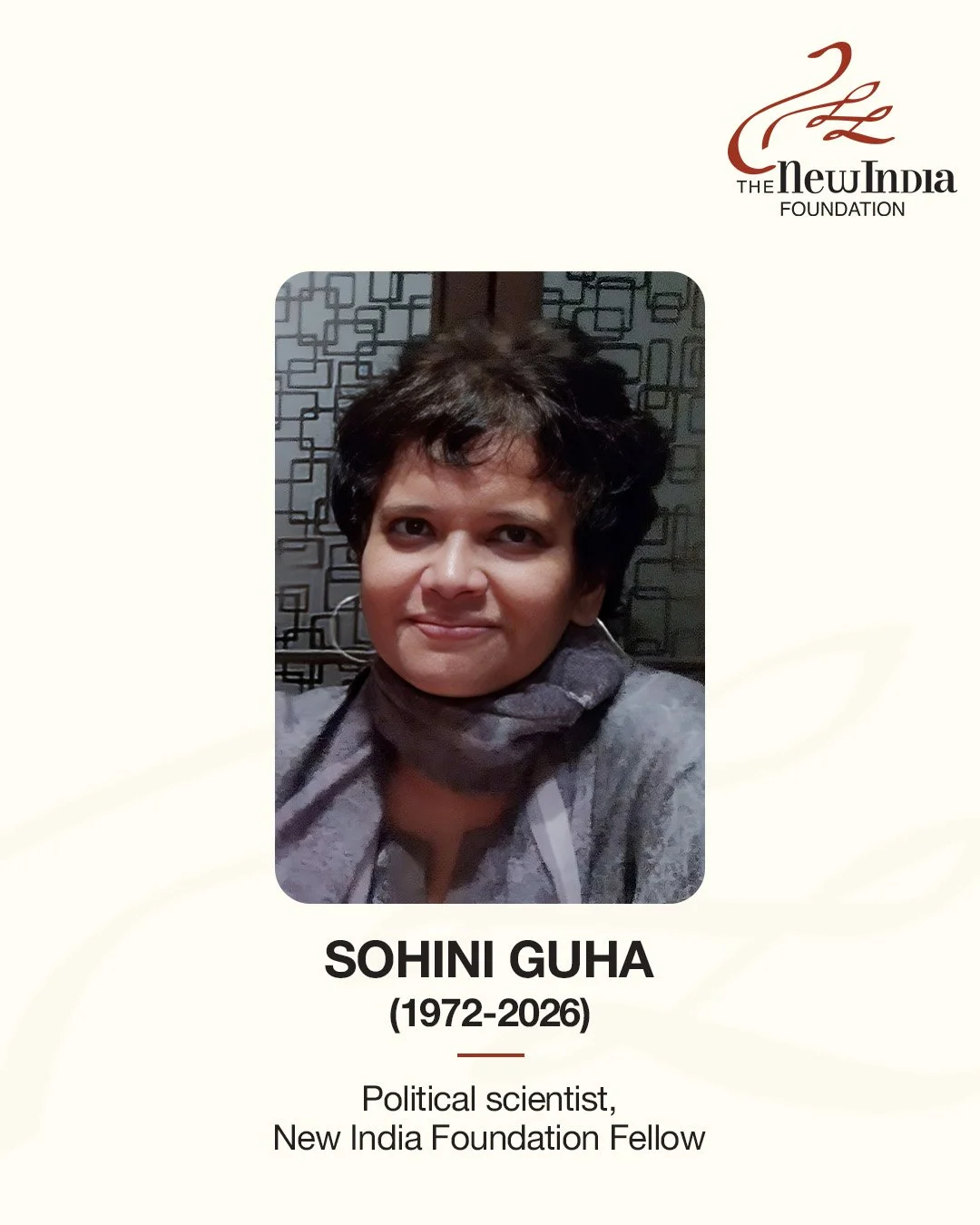
Sohini Guha (1972-2026)
It is devastating to have to write a tribute to someone so much younger, who I had the privilege of knowing in several different capacities: as a student, a professional colleague, a friend and, most recently, as a Fellow of the New India Foundation. Sohini was my student at the Centre for Political Studies, Jawaharlal Nehru University, and I supervised her M.Phil. dissertation before she went on to McGill University, Canada, for doctoral studies.
In 2013, Sohini was awarded an NIF Fellowship, to write a book titled Low Caste Politics in North India. She had already completed her doctorate on this subject at McGill. However, being the perfectionist that she was, Sohini refused to give in to the subtle pressure that is characteristic of the academic profession, to quickly turn the thesis into a book. Given the volatility of politics in the states of Uttar Pradesh and Bihar, she chose to undertake fresh fieldwork for the book, and spent many months travelling and conducting interviews.
Returning to a busy schedule as an academic – with administrative duties – at the Department of Political Science in the University of Delhi, Sohini struggled to devote time to the book. This was not helped by the health challenges she began to face, including the consequences of misdiagnosis and over-medication. Eventually, she quit her job at the University of Delhi and moved back home to Kolkata where, along with her sister Maléni, she dealt with affairs relating to their parents’ literary and cultural estate. We last met, in February 2025, when she attended the NIF Retreat in Bangalore. She seemed to be in good form and optimistic about being able to devote herself, full time, to the writing of her book. Unfortunately, this task remained incomplete as Sohini suddenly succumbed, last week, to an unexpected infection and its cascading after-effects.
Sohini was a truly gifted scholar, who brought to her writing an uncommon depth of understanding and orginality of interpretation. In 2021, she published a widely admired article in the prestigious journal Modern Asian Studies, interpreting low caste politics in Uttar Pradesh and Bihar in terms of democratic theory: the tension between procedural and substantive democracy; how instant egalitarian fixes generated legitimacy; and the impact, on public culture, of the prioritizing of right outcomes over proper procedures. The striving for excellence, and indeed perfection, was the hallmark of her outstanding scholarship, marked not just by analytical depth, but also by nuance, sophistication and elegant writing.
Sohini was incredibly unassuming. Until her father’s passing in 2021 – widely noted in the press – I was completely unaware of her distinguished literary and cultural pedigree: her father, Buddhadev Guha, was an extremely well-known Bengali writer and artist and her mother, Ritu Guha, was an iconic exponent of Rabindra Sangeet. Sohini herself played the piano and had expressed, to friends, her intention to return to music lessons soon.
I am filled with sadness that someone so young and brilliant was dealt such a bad hand in terms of her health, and was so chronically unlucky. I will miss Sohini – her unfinished life and her unfinished book.
Niraja Jayal