Indira Chowdhury

Indira Chowdhury headed the Centre for Public History at the Srishti Institute of Art, Design and Technology in Bengaluru, India from 2010-2023. She has a PhD in History from the School of Oriental and African Studies, London. Formerly a professor of English at Jadavpur University, Kolkata, India. Dr Chowdhury’s academic interests include history, women’s studies, science history, cultural studies, translation, and lexicography.
NIF Books
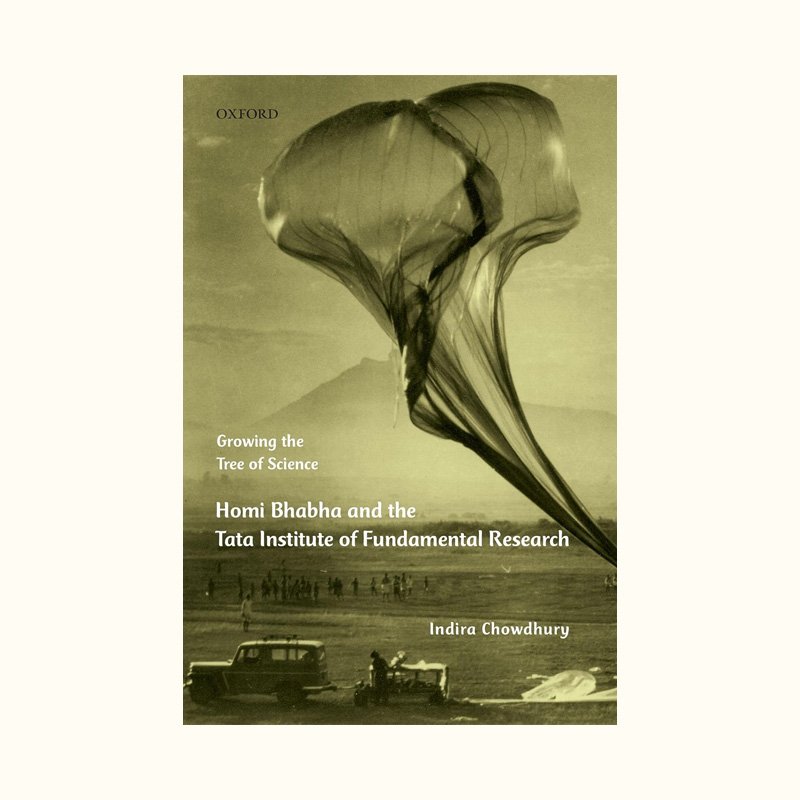
How does a premier institute of science come into being? How does it foster a culture promoting free thinking and original research? What impact do the policies of a newly independent nation have on the way it functions? Exploring such themes and analysing the dissonances between institutional records and individual recollections, this book narrates the unique history of the Tata Institute of Fundamental Research (TIFR), Mumbai.
Acutely aware that a scientific temper had not been nurtured in colonial India, Cambridge-trained physicist Homi Bhabha, who later came to be known as the architect of India’s atomic energy programme, wished to plant the tree of science on Indian soil. Thus was born TIFR on 19 December 1945. What followed were years of dynamic growth and struggle during which some of the best minds from across the world worked as well as taught at the institute.
Using both archival documents and detailed interviews, Growing the Tree of Science blends history and memory to reinterpret institutional legacy by moving beyond Bhabha’s individual efforts and bringing to light the role of younger scientists during the formative years of TIFR. In the process emerges a fascinating account in which personal connections, novel forms of philanthropy, art and architecture, and international training networks, all come together in creating a vibrant culture of science at TIFR.
Purchase: Amazon
Reviews:
‘Professor Indira Chowdhury has produced an excellent book that deals with institutionalisation of science in India in the era of transition from dependence to independence. It traces the evolution of an exceptional institute, the Tata Institute of Fundamental Research, and the role and vision of its founder Homi Bhabha. This is no hagiography but a nuanced academic work based on archival data, personal interviews and an objective insight. Here, both individual memory and institutional memory coalesce.’ - Deepak Kumar, History and Sociology of South Asia
‘In Growing the Tree of Science: Homi Bhabha and the Tata Institute of Fundamental Research, Indira Chowdhury examines the intertwined processes of scientific institution building and nation building in mid-twentieth-century India by focusing on the emergence of one of India's premier scientific institutions. Chowdhury analyses the social, political and cultural processes of institution building that marked Bhabha's efforts to create a distinctive institutional culture for the pursuit of science at the Tata Institute of Fundamental Research in post-independence India.’- Charu Singh, South Asian History and Culture
Other books by this author: