
NS Gundur

N. S. Gundur is an Indian academic, literary critic, and translator. He serves as a professor of English literature at Tumkur University in Karnataka. He is widely recognized for his work in cultural theory and for his translations that bridge Kannada and English literary traditions.
NIF Books
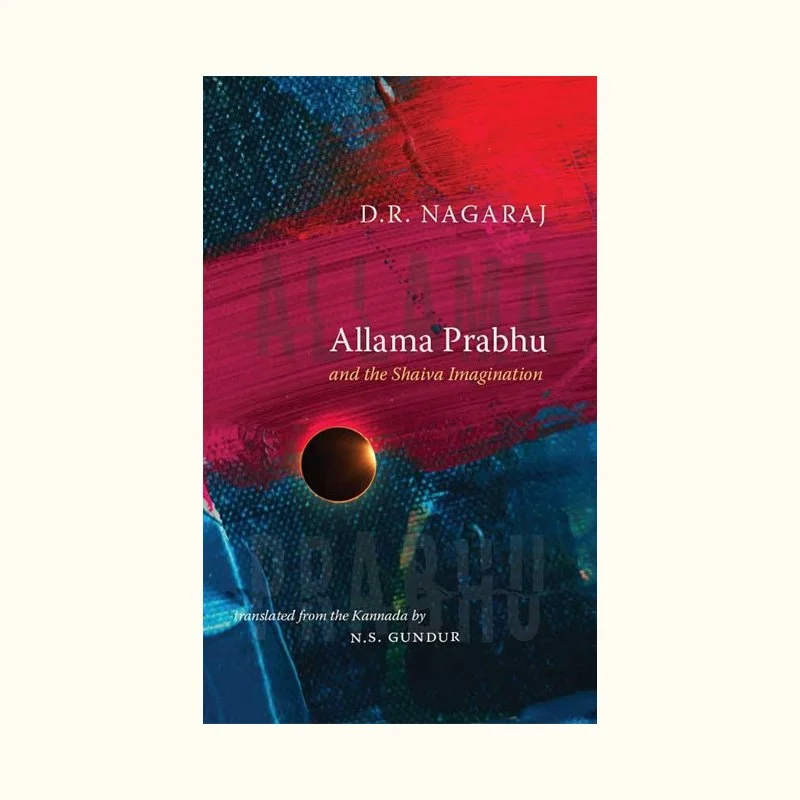
In his last, profoundly innovative work, D. R. Nagaraj (1954–1998) engages with the twelfth-century Shaiva mystic and philosopher-poet Allama Prabhu, whose enigmatic writings have perplexed many and thus resisted analysis. Nagaraj situates Allama in three intellectual contexts: the medieval philosophical world built around the worship of Shiva; the pan-Indian bhakti tradition; and, most broadly, Indian mystical thought. This framework enables a reconstruction of Allama through the poet's engagement with fellow poet-spiritualists (vachanakaras) such as Basava, as well as with the Kashmiri Shaiva philosopher Abhinavagupta and the founder of Hindu monasticism Gorakhnath. Nagaraj's close readings of Allama's vachanas offer a vision of Shaiva bhakti that seems to contradict the erotic and romantic expressive modes of Sringara rasa while tracing the limits of language for an understanding of the divine. Allama, Nagaraj suggests, is an epistemological iconoclast who expands the horizons of language and thought.
Through these explorations, Nagaraj decolonizes the standard modes of inquiry and critiques certain settled notions in Indian philosophy, revealing himself as a postcolonial scholar whose "hermeneutics of suspicion" leads to a novel understanding of Indian texts and traditions. Unifying literary criticism with critical theory, philosophical inquiry, and the history of ideas, the book's focus on a specific religious tradition—Virashaivism—is never singular, making it as much a work for scholars of Indian spiritualism and religious thought as for those interested in frameworks that transgress Eurocentricism. Translated into English by Kannada philosopher N. S. Gundur, this is a major contribution to studies of Indian philosophy and literature.
Reviews:
“When D. R. Nagaraj died in 1998 at the age of forty-four, India—and the world—lost a thinker of extraordinary originality, insight, and subtlety. D. R. recognized as deeply as Walter Benjamin that 'there is no document of civilization which is not at the same time a document of barbarism,' and he had a way of bringing his readers into the heart of both—from the depths of caste violence to the heights of poetry and philosophy. That an English readership at last has access to his major work on Allama Prabhu, the most important and most enigmatic of Virashaiva masters, is a precious gift, for which we are deeply indebted to N. S. Gundur. His edition-translation is not just an homage, however, but is itself a remarkable contribution to literary and historical scholarship.” — Sheldon Pollock, author of The Language of the Gods in the World of Men: Sanskrit, Culture, and Power in Premodern India
“Allama Prabhu and the Shaiva Imagination (Permanent Black, 2025) belongs to the other end of the spectrum of writings on Indian intellectual history that focuses on non-Brahminic and non-Sanskrit sources. Authored by D R Nagaraj, among the most profound cultural critics in post-Independence India, the Kannada book was originally published posthumously in 1999. Now we have its long awaited English rendering by N S Gundur, an act of linguistic hospitality that succeeds in bringing Nagaraj’s complex ideas to the English reader. The book focusses on Allama Prabhu, one of the great 12th century vachanakaras in the Virashaiva movement. In the course of establishing Allama Prabhu as a poet and philosopher, Nagaraj questions the received ways of narrating the history of Indian philosophy and literature that have neglected the vernacular and desi imagination that expresses itself through images and metaphors.
Instead of using Western literary theory, Nagaraj interprets Allama’s vachanas through the conceptual resources of the Shaiva Mimansa tradition and sets up a conversation with Kashmiri philosopher Abhinavagupta. Above all, Nagaraj engages with Allama in a creative and critical manner, refusing to simply follow like a “flock of parrots”. This book is shot through with a critical lens: Allama critiques the received Virashaiva tradition; Nagaraj critiques Allama and the translator offers a critique of Nagaraj.”- Yogendra Yadav