Richa Kumar

Richa Kumar is Associate Professor of Sociology and Science and Technology Studies (STS) in the Department of Humanities and Social Sciences at the Indian Institute of Technology, Delhi. She has been studying issues at the intersection of agriculture, food, human health and the environment from a social science and STS perspective for the last 20 years. She is a recipient of the inaugural Elizabeth Adiseshiah Memorial Award (2019), and is a member of the Network of Rural and Agrarian Studies (NRAS). She completed her Ph.D. from the Science, Technology and Society Program at the Massachusetts Institute of Technology, Cambridge, USA.
NIF Books
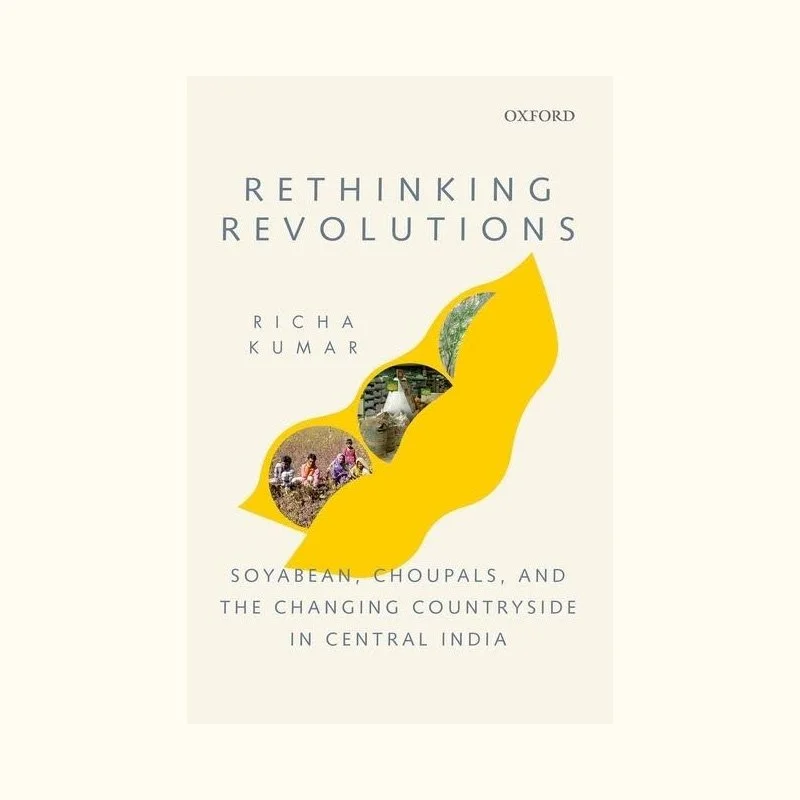
The last forty years have witnessed massive agrarian change in the Malwa region of central India—beginning with the introduction of soyabean cultivation in the 1970s, known as the ‘yellow revolution’, and new information technology–based markets in the 2000s, referred to as choupals. This ethnographic study is aimed at revisiting these changes which were proclaimed as technology-mediated development.
Examining the claims of prosperity and empowerment of farmers, Rethinking Revolutions challenges the notion that science and technology by themselves can bring unparalleled economic growth and prosperity to rural India. It argues that both techno-managerial ways of understanding and evaluating agriculture, as also those which emphasize the lenses of caste, class, and gender, are inadequate in capturing the diverse processes at work in shaping the lives of rural people.
Highlighting the role of the environment and technology—not in deterministic ways, but as non-human forces working upon and with human agents—it suggests that both the social and the technical must be considered together to understand the specific trajectories of agrarian change. Drawing upon science and technology studies, together with critical scholarship on the political economy of development and agrarian change, this book shows how people and their environs have reconfigured each other in producing the world they inhabit, thus contributing towards new theoretical framings of agriculture and rural transformation.
Other books by this author: