Gautam Bhatia

Gautam Bhatia is a Delhi-based advocate and an Adjunct Professor at the Jindal Global Law School. He is the author of The Transformative Constitution (2019), Unsealed Covers (2023) and The Indian Constitution: A Conversation with Power (2025). He holds a BA/LLB degree from the National Law School of India University (2011), a BCL and MPhil from the University of Oxford (2012 - 2013) and an LLM from Yale Law School (2014). He has been involved in several contemporary constitutional cases, such as the challenge to the abrogation of Article 370, the electoral bonds case, the right to privacy case, and others. His work has been cited by the Indian Supreme Court, and by various High Courts. He has served as amicus curiae on two occasions before the Supreme Court of Kenya. He is also the author of three science-fiction novels, The Wall (2020), The Horizon (2021), and The Sentence (2024).
NIF Books
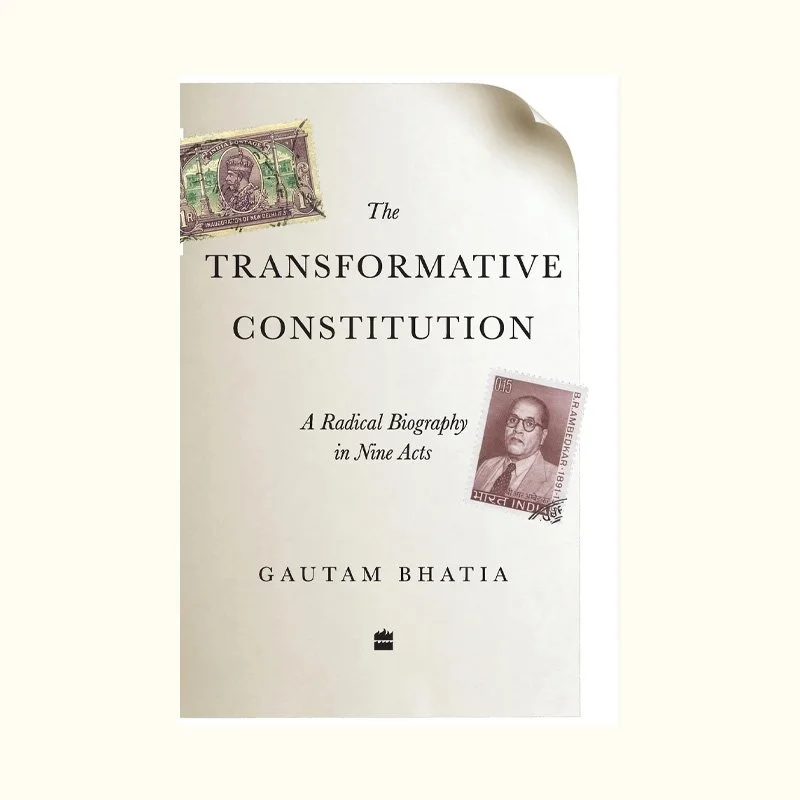
The Constitution of India embodies a moment of profound transformation–one in which the subjects of an alien, colonial regime became the free citizens of a republic. Yet, this is the story of constitutions the world over. The Indian Constitution was, however, transformative in a second sense as well: it sought a thorough reconstruction of State and society itself.
It recognized that, unlike in the West, the State had never been the only power centre in India. Deeply pervasive hierarchies were maintained by structures that took various forms–caste, for instance–and the State had limited authority to interfere. The Constitution, then, was intended to transform not just the political status of Indians from subjects to citizens, but also the social relationships on which legal and political edifices rested.
The Transformative Constitution is an attempt to understand–and to give primacy to–this original transformative vision of the Constitution.
Gautam Bhatia interprets India’s founding document in a way which is faithful to its text, structure, and history, and above all to its overarching commitment to political and social transformation. He picks out nine cases–and analyses their judgements in painstaking detail in the context of seven decades’ worth of Indian jurisprudence–to show how they advance the core principles of equality, fraternity, and liberty enshrined in it.
Reviews:
‘A work of serious scholarship; also a social-democratic manifesto … The Transformative Constitution is a formidable achievement. Right at the start, Bhatia writes that his book doesn’t claim to be the definitive reading of India’s Constitution. This is mannerly, modest and untrue. This book’s reason for being is the author’s ambition to define the Constitution as a progressive charter and to choose the landmark cases that should determine its future interpretation. To this end he marshals a knowledge of history, political ideas and jurisprudence that would be demoralizing if it weren’t so austerely deployed
Bhatia’s commitment to lucidity and systematic argument, where every premise is stated and every argument outlined before being discursively made, is so far removed from the riddling opaqueness of desi academic writing that it feels foreign. If the book has an Indian ancestor it is Amartya Sen’s The Idea of Justice. In its range, its social democratic moorings and its style of public reasoning, it earns the comparison.
For liberal readers, The Transformative Constitution is a purpose-built arsenal. For conservatives, it is a guide to the best legal arguments liberals didn’t know they had. For lawyers and lay citizens alike, this is an indispensable book.’ —Mukul Kesavan
‘Gautam Bhatia is an excellent jurist—the best among the best. A joy to read. There is much to learn from him.’ —Rajeev Dhavan
‘Gautam Bhatia’s formulation ensures that the Constitution is not “frozen in time”, nor does it give judges a blank cheque to rewrite the Constitution ... As a genre, The Transformative Constitution has more in common with Lenin’s “What Is to Be Done?” than dry treatises on constitutional interpretation ... Despite throwing out both precedence and protocol, Bhatia is neither a revolutionary nor an apostate, what he offers is a set of interpretive tools and techniques to renew faith in the transformative vision of the Constitution’ —Rohit De
‘This biography of the Indian Constitution is not about the law today but about the ideal equilibrium. There are few practitioners and scholars who are better positioned than Bhatia to provide both insight and perspective. This book will help many in the path toward legal literacy and thus a fuller and more participative citizenship.’ —Nikhil Govind
‘Advances the argument that the Constitution, despite elements of continuity with a colonial administration, is a fundamentally
“transformative” document. In pragmatic, calculated ways, grounds Indian democracy in the principles of liberty, equality and fraternity, insulating it from the vagaries of electoral politics as well as oppressive social hierarchies.’ —Rihan Najib
‘Makes a unique contribution to the literature on Indian constitutional law. The book’s methodology has inspiringly adopted Edward Said’s contrapuntal approach to identify the Constitution as a value-laden document beyond its tangible text. Interestingly, by the project’s nature, The Transformative Constitution is comparable to Akhil Reed Amar’s America’s Constitution: A Biography.’ —Sandeep Suresh, International Journal of Constitutional Law
Book Awards:
Shortlisted for the Tata Literature Live Non-Fiction Book of the Year 2019
Shortlisted for the Hindu Prize for Non-Fiction, 2019
Other books by this author: